2026 CKS Vce Download | CKS 100% Free Reliable Dumps
Wiki Article
P.S. Free & New CKS dumps are available on Google Drive shared by PassReview: https://drive.google.com/open?id=1y_cHUDadvpt08HBmWSCef_6Uk0JzOPdR
If you are still a student, you must have learned from the schoolmaster how difficult it is to go out to work now. If you have already taken part in the work, you must have felt deeply the pressure of competition in society. CKS exam materials can help you stand out in the fierce competition. After using our CKS Study Materials, you have a greater chance of passing the CKScertification, which will greatly increase your soft power and better show your strength.
The CKS exam is a hands-on, performance-based exam that tests the candidate's ability to secure a Kubernetes cluster. CKS exam consists of 17 scenarios that simulate real-world situations that a Kubernetes administrator might face. The scenarios are designed to test the candidate's understanding of Kubernetes security concepts, their ability to identify and mitigate common vulnerabilities, and their knowledge of best practices for securing Kubernetes clusters. CKS exam is conducted online and can be taken from anywhere in the world. Candidates are required to pass the exam to earn the CKS certification, which is valid for two years.
Linux Foundation CKS (Certified Kubernetes Security Specialist) Exam is a certification program that validates the skills and knowledge of professionals in securing Kubernetes clusters. Kubernetes is a popular open-source container orchestration platform that is widely used by organizations to manage and deploy containerized applications. As Kubernetes adoption has grown, the need for skilled and knowledgeable security professionals to secure these clusters has also increased.
The CKS Certification Exam covers a wide range of topics, including Kubernetes cluster architecture, network security, container security, access management, and security auditing. CKS exam is designed to assess the candidate's knowledge of security best practices, as well as their ability to implement and manage security controls effectively. Certified Kubernetes Security Specialist (CKS) certification exam is vendor-neutral, which means that it is not tied to any particular technology or platform, and is recognized by organizations worldwide.
CKS Reliable Dumps - CKS Latest Exam Testking
If you lack confidence for your exam, choose the CKS study materials of us, you will build up your confidence. CKS Soft test engine strengthen your confidence by stimulating the real exam environment, and it supports MS operating system, it has two modes for practice and you can also practice offline anytime. Besides CKS Study Materials are famous for high-quality. You can pass the exam by them. You can receive the latest version for one year for free if you choose CKS exam dumps of us, and the update version will be sent to your email automatically.
Linux Foundation Certified Kubernetes Security Specialist (CKS) Sample Questions (Q32-Q37):
NEW QUESTION # 32
SIMULATION
Create a network policy named allow-np, that allows pod in the namespace staging to connect to port 80 of other pods in the same namespace.
Ensure that Network Policy:-
1. Does not allow access to pod not listening on port 80.
2. Does not allow access from Pods, not in namespace staging.
Answer:
Explanation:
See the Explanation belowExplanation:
apiVersion: networking.k8s.io/v1
kind: NetworkPolicy
metadata:
name: network-policy
spec:
podSelector: {} #selects all the pods in the namespace deployed
policyTypes:
- Ingress
ingress:
- ports: #in input traffic allowed only through 80 port only
- protocol: TCP
port: 80
NEW QUESTION # 33
Cluster: qa-cluster Master node: master Worker node: worker1 You can switch the cluster/configuration context using the following command: [desk@cli] $ kubectl config use-context qa-cluster Task: Create a NetworkPolicy named restricted-policy to restrict access to Pod product running in namespace dev. Only allow the following Pods to connect to Pod products-service: 1. Pods in the namespace qa 2. Pods with label environment: stage, in any namespace
Answer:
Explanation: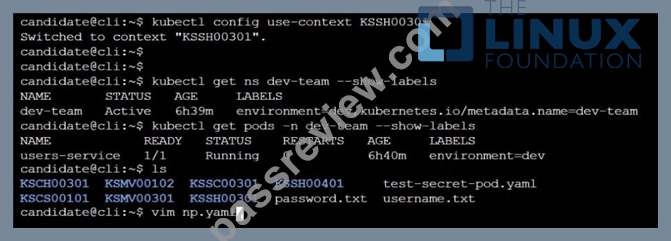
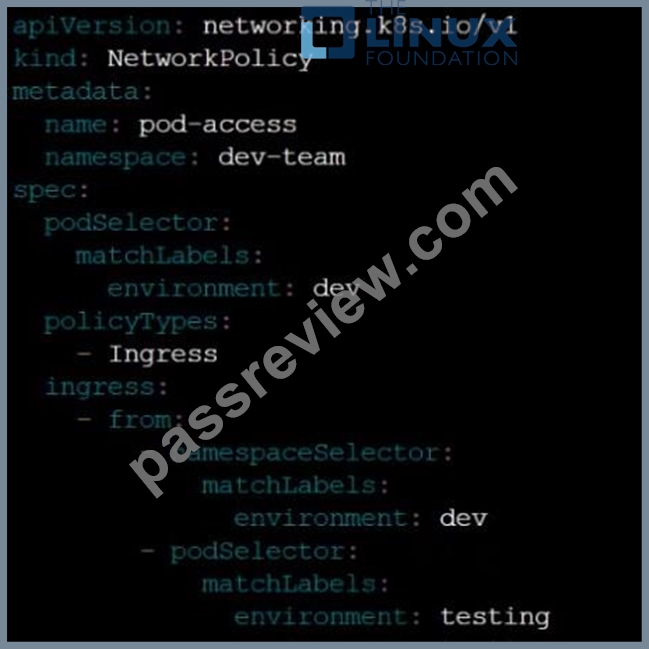
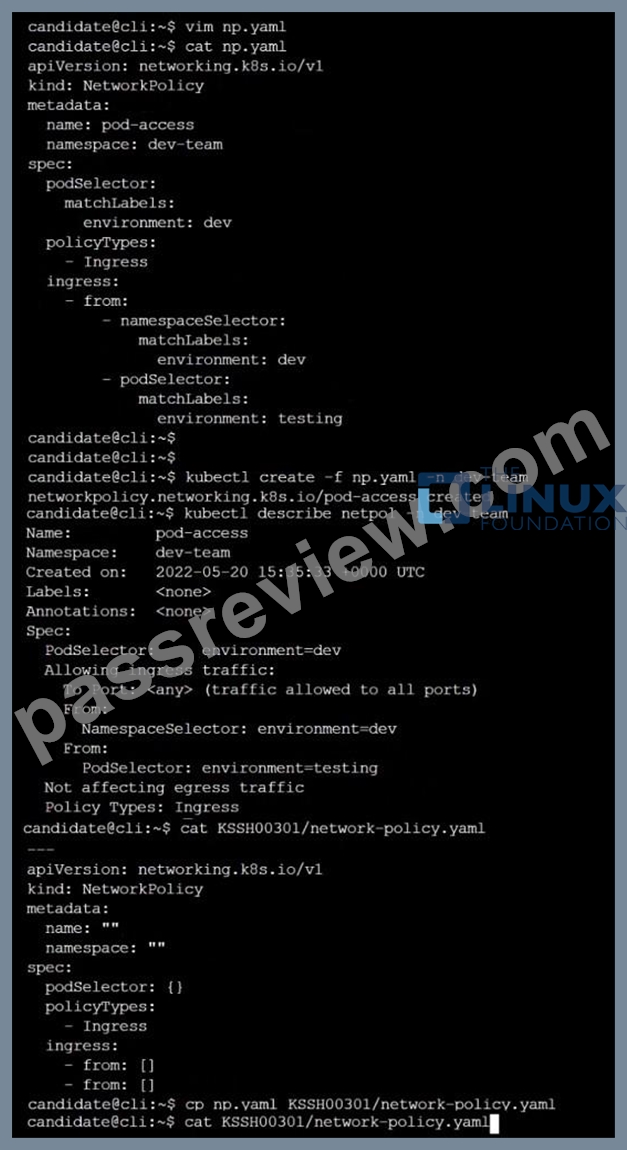
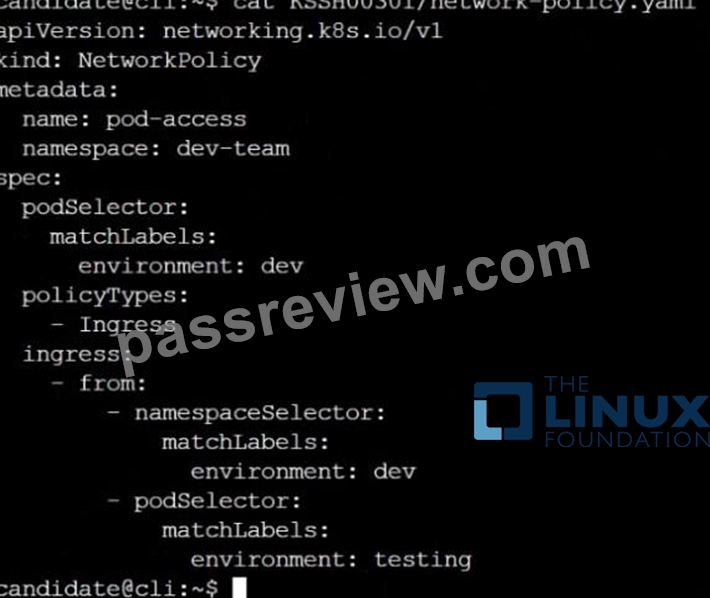
NEW QUESTION # 34
Secrets stored in the etcd is not secure at rest, you can use the etcdctl command utility to find the secret value for e.g:- ETCDCTL_API=3 etcdctl get /registry/secrets/default/cks-secret --cacert="ca.crt" --cert="server.crt" --key="server.key" Output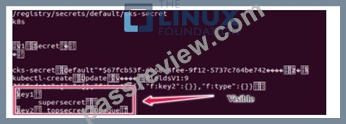
Using the Encryption Configuration, Create the manifest, which secures the resource secrets using the provider AES-CBC and identity, to encrypt the secret-data at rest and ensure all secrets are encrypted with the new configuration.
Answer:
Explanation:
ETCD secret encryption can be verified with the help of etcdctl command line utility.
ETCD secrets are stored at the path /registry/secrets/$namespace/$secret on the master node.
The below command can be used to verify if the particular ETCD secret is encrypted or not.
# ETCDCTL_API=3 etcdctl get /registry/secrets/default/secret1 [...] | hexdump -C
NEW QUESTION # 35
You can switch the cluster/configuration context using the following command: [desk@cli] $ kubectl config use-context test-account Task: Enable audit logs in the cluster.
To do so, enable the log backend, and ensure that:
1. logs are stored at /var/log/Kubernetes/logs.txt
2. log files are retained for 5 days
3. at maximum, a number of 10 old audit log files are retained
A basic policy is provided at /etc/Kubernetes/logpolicy/audit-policy.yaml. It only specifies what not to log. Note: The base policy is located on the cluster's master node.
Edit and extend the basic policy to log: 1. Nodes changes at RequestResponse level 2. The request body of persistentvolumes changes in the namespace frontend 3. ConfigMap and Secret changes in all namespaces at the Metadata level Also, add a catch-all rule to log all other requests at the Metadata level Note: Don't forget to apply the modified policy.
Answer:
Explanation:
$ vim /etc/kubernetes/log-policy/audit-policy.yaml
- level: RequestResponse
userGroups: ["system:nodes"]
- level: Request
resources:
- group: "" # core API group
resources: ["persistentvolumes"]
namespaces: ["frontend"]
- level: Metadata
resources:
- group: ""
resources: ["configmaps", "secrets"]
- level: Metadata
$ vim /etc/kubernetes/manifests/kube-apiserver.yaml Add these
- --audit-policy-file=/etc/kubernetes/log-policy/audit-policy.yaml
- --audit-log-path=/var/log/kubernetes/logs.txt
- --audit-log-maxage=5
- --audit-log-maxbackup=10
Explanation
[desk@cli] $ ssh master1 [master1@cli] $ vim /etc/kubernetes/log-policy/audit-policy.yaml apiVersion: audit.k8s.io/v1 # This is required.
kind: Policy
# Don't generate audit events for all requests in RequestReceived stage.
omitStages:
- "RequestReceived"
rules:
# Don't log watch requests by the "system:kube-proxy" on endpoints or services
- level: None
users: ["system:kube-proxy"]
verbs: ["watch"]
resources:
- group: "" # core API group
resources: ["endpoints", "services"]
# Don't log authenticated requests to certain non-resource URL paths.
- level: None
userGroups: ["system:authenticated"]
nonResourceURLs:
- "/api*" # Wildcard matching.
- "/version"
# Add your changes below
- level: RequestResponse
userGroups: ["system:nodes"] # Block for nodes
- level: Request
resources:
- group: "" # core API group
resources: ["persistentvolumes"] # Block for persistentvolumes
namespaces: ["frontend"] # Block for persistentvolumes of frontend ns
- level: Metadata
resources:
- group: "" # core API group
resources: ["configmaps", "secrets"] # Block for configmaps & secrets
- level: Metadata # Block for everything else
[master1@cli] $ vim /etc/kubernetes/manifests/kube-apiserver.yaml
apiVersion: v1
kind: Pod
metadata:
annotations:
kubeadm.kubernetes.io/kube-apiserver.advertise-address.endpoint: 10.0.0.5:6443 labels:
component: kube-apiserver
tier: control-plane
name: kube-apiserver
namespace: kube-system
spec:
containers:
- command:
- kube-apiserver
- --advertise-address=10.0.0.5
- --allow-privileged=true
- --authorization-mode=Node,RBAC
- --audit-policy-file=/etc/kubernetes/log-policy/audit-policy.yaml #Add this
- --audit-log-path=/var/log/kubernetes/logs.txt #Add this
- --audit-log-maxage=5 #Add this
- --audit-log-maxbackup=10 #Add this
...
output truncated
Note: log volume & policy volume is already mounted in vim /etc/kubernetes/manifests/kube-apiserver.yaml so no need to mount it. Reference: https://kubernetes.io/docs/tasks/debug-application-cluster/audit/
NEW QUESTION # 36
SIMULATION
Context:
Cluster: prod
Master node: master1
Worker node: worker1
You can switch the cluster/configuration context using the following command:
[desk@cli] $ kubectl config use-context prod
Task:
Analyse and edit the given Dockerfile (based on the ubuntu:18:04 image)
/home/cert_masters/Dockerfile fixing two instructions present in the file being prominent security/best-practice issues.
Analyse and edit the given manifest file
/home/cert_masters/mydeployment.yaml fixing two fields present in the file being prominent security/best-practice issues.
Note: Don't add or remove configuration settings; only modify the existing configuration settings, so that two configuration settings each are no longer security/best-practice concerns.
Should you need an unprivileged user for any of the tasks, use user nobody with user id 65535
Answer:
Explanation:
See the Explanation belowExplanation:
1. For Dockerfile: Fix the image version & user name in Dockerfile
2. For mydeployment.yaml : Fix security contexts
Explanation:
[desk@cli] $ vim /home/cert_masters/Dockerfile
FROM ubuntu:latest # Remove this
FROM ubuntu:18.04 # Add this
USER root # Remove this
USER nobody # Add this
RUN apt get install -y lsof=4.72 wget=1.17.1 nginx=4.2
ENV ENVIRONMENT=testing
USER root # Remove this
USER nobody # Add this
CMD ["nginx -d"]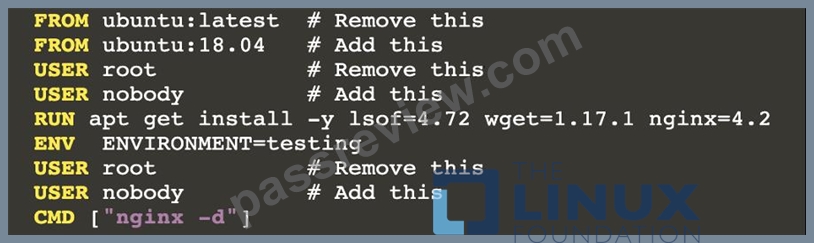
[desk@cli] $ vim /home/cert_masters/mydeployment.yaml
apiVersion: apps/v1
kind: Deployment
metadata:
creationTimestamp: null
labels:
app: kafka
name: kafka
spec:
replicas: 1
selector:
matchLabels:
app: kafka
strategy: {}
template:
metadata:
creationTimestamp: null
labels:
app: kafka
spec:
containers:
- image: bitnami/kafka
name: kafka
volumeMounts:
- name: kafka-vol
mountPath: /var/lib/kafka
securityContext:
{"capabilities":{"add":["NET_ADMIN"],"drop":["all"]},"privileged": True,"readOnlyRootFilesystem": False, "runAsUser": 65535} # Delete This
{"capabilities":{"add":["NET_ADMIN"],"drop":["all"]},"privileged": False,"readOnlyRootFilesystem": True, "runAsUser": 65535} # Add This resources: {} volumes:
- name: kafka-vol
emptyDir: {}
status: {}
Pictorial View:
[desk@cli] $ vim /home/cert_masters/mydeployment.yaml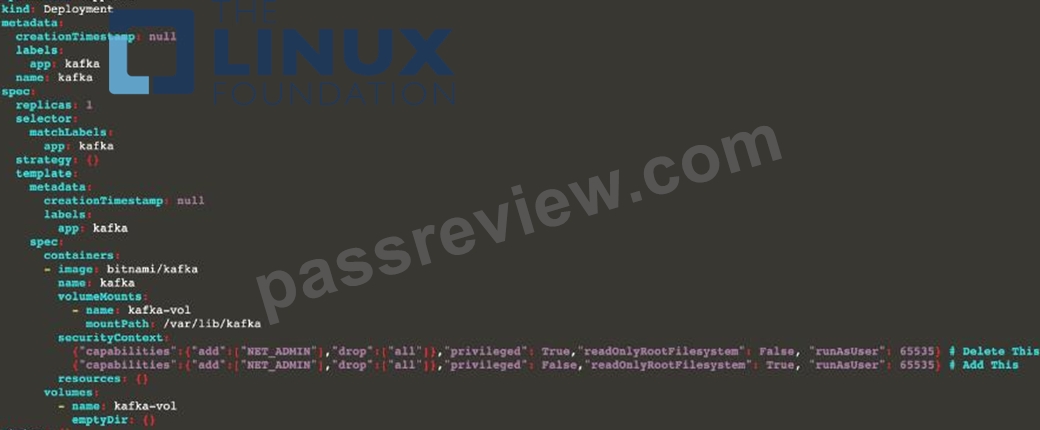
NEW QUESTION # 37
......
With all types of CKS test guide selling in the market, lots of people might be confused about which one to choose. Many people can’t tell what kind of CKS study dumps and software are the most suitable for them. Our company can guarantee that our CKS Actual Questions are the most reliable. Having gone through about 10 years’ development, we still pay effort to develop high quality CKS study dumps and be patient with all of our customers, therefore you can trust us completely.
CKS Reliable Dumps: https://www.passreview.com/CKS_exam-braindumps.html
- New CKS Exam Practice ???? CKS Valid Exam Review ???? CKS Valid Exam Review ???? Download ☀ CKS ️☀️ for free by simply searching on 《 www.prepawayexam.com 》 ????CKS Valid Exam Labs
- One of the Best Ways to Prepare For the CKS ???? Download ⏩ CKS ⏪ for free by simply entering 《 www.pdfvce.com 》 website ????Valid CKS Exam Notes
- Easy To Use and Compatible www.testkingpass.com Linux Foundation CKS Questions Formats ➕ Go to website ⏩ www.testkingpass.com ⏪ open and search for [ CKS ] to download for free ????CKS Exams Collection
- Boost Your Confidence with Linux Foundation CKS Certified Kubernetes Security Specialist (CKS) Test ???? Enter ⏩ www.pdfvce.com ⏪ and search for [ CKS ] to download for free ????Mock CKS Exams
- CKS exam dumps and Linux Foundation CKS exam Simulator ???? Easily obtain free download of ➠ CKS ???? by searching on ➥ www.examcollectionpass.com ???? ????CKS Exams Collection
- New CKS Test Papers ???? Valid CKS Exam Notes ???? New CKS Exam Practice ???? Open ▛ www.pdfvce.com ▟ and search for ➽ CKS ???? to download exam materials for free ????CKS Updated Test Cram
- CKS Free Exam Questions ???? CKS Valid Exam Review ???? CKS Updated Test Cram ???? Copy URL { www.exam4labs.com } open and search for ➠ CKS ???? to download for free ????Mock CKS Exams
- New CKS Exam Practice ???? Visual CKS Cert Test ???? Valid CKS Exam Notes ???? Go to website ▷ www.pdfvce.com ◁ open and search for ✔ CKS ️✔️ to download for free ????CKS Updated Test Cram
- Linux Foundation CKS Vce Download: Certified Kubernetes Security Specialist (CKS) - www.practicevce.com Ensure you Pass Exam ???? Go to website ▷ www.practicevce.com ◁ open and search for “ CKS ” to download for free ????Best CKS Study Material
- CKS Free Exam Questions ???? CKS Valid Exam Review ⛹ Study CKS Tool ???? Search for { CKS } and download it for free immediately on “ www.pdfvce.com ” ????Mock CKS Exams
- The Best CKS Vce Download - Complete CKS Exam Tool Guarantee Purchasing Safety ???? Search for [ CKS ] and download exam materials for free through ⇛ www.validtorrent.com ⇚ ????Latest CKS Exam Duration
- songtr.ee, jimttup575826.homewikia.com, mariahntgm661601.goabroadblog.com, socialbraintech.com, amieaccv408078.get-blogging.com, deborahrqay342050.prublogger.com, lewisazhz985048.techionblog.com, barbaraflib057067.wikikali.com, myfirstbookmark.com, laraexgk567571.blog-a-story.com, Disposable vapes
2026 Latest PassReview CKS PDF Dumps and CKS Exam Engine Free Share: https://drive.google.com/open?id=1y_cHUDadvpt08HBmWSCef_6Uk0JzOPdR
Report this wiki page